Location: Ballinamore Bridge, Ballinasloe, Co. Galway, H53 CK00
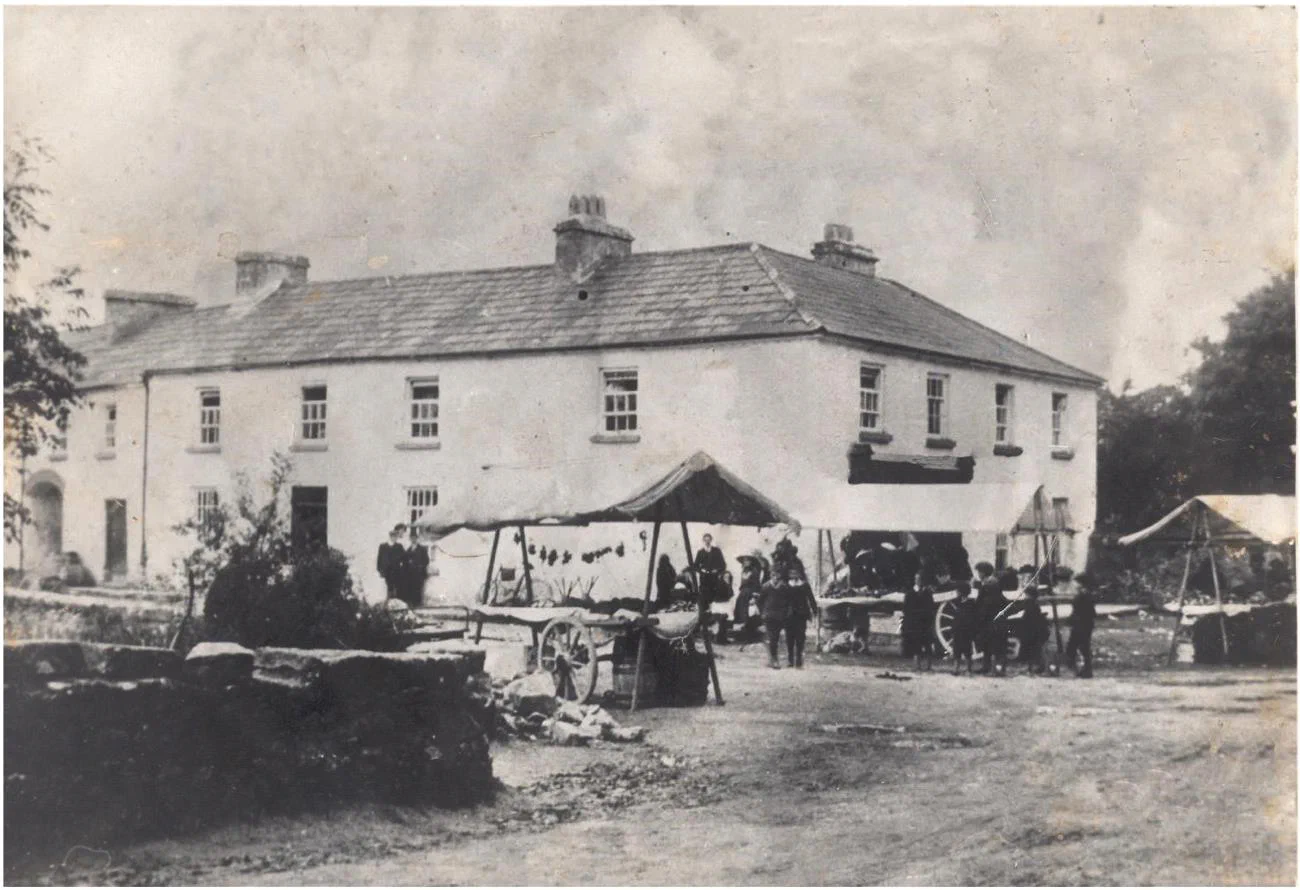
Ballinamore, (Béal an Átha Móir) meaning Mouth of the Great Ford, is located at the point where the river Shiven could be forded even during the winter floods. This strategic location, on the route between Roscommon and Galway city, was an important site militarily and thus had a barracks located there with a courthouse sometime later.
This continued after the bridge was built around the 1830s, until the barracks and courthouse were destroyed by the IRA in the summer of 1920.
The Military Archives for the 1917-23 period have been digitized recently and are now accessible online. The records from the Military Service Pensions Collection (MSPC) in particular provide good information on the IRA organization and activities at local level. They consist of individual applications for service pensions as well as Brigade Activity Reports and membership rolls, compiled retrospectively in the 1930s.
This sketch map from the East Galway brigade report [1] gives a rough outline of Mountbellew Battalion area.
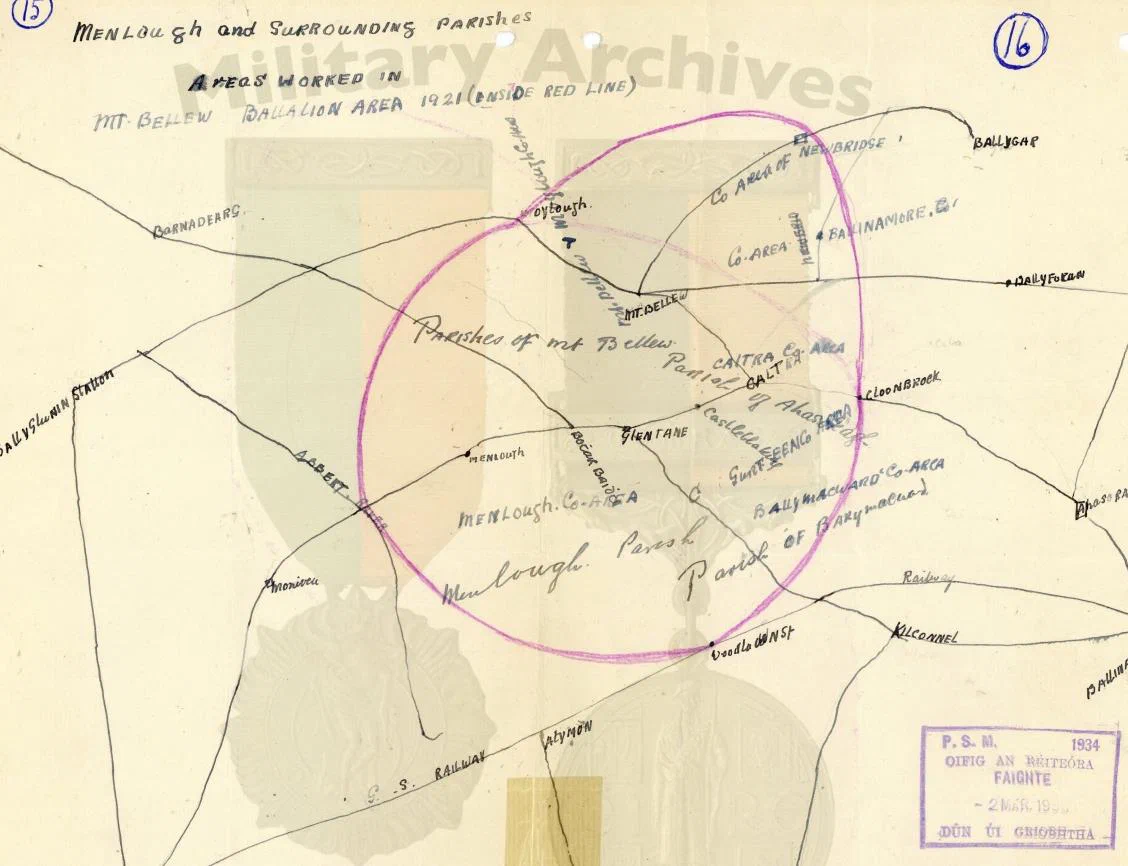
Ballinamore Company (abbreviates to Coy in military parlance) was part of this battalion, as was Newbridge Coy.
Ballygar Coy was in South Roscommon Brigade, so would report up through a different command structure.
The 1934 Military Service Pensions Act defined two critical dates for Brigade Committees to list active members in the IRA Nominal Rolls. The first was 11 July 1921 which marked the end of the War of Independence. The second was 1 July 1922, marking the outbreak of the Civil War.
These extracts from East Galway Brigade nominal roll [2] name the officers and men of Ballinamore Coy, who were active in the War of Independence, in the 3 months up to the 11 July 1921 critical date.
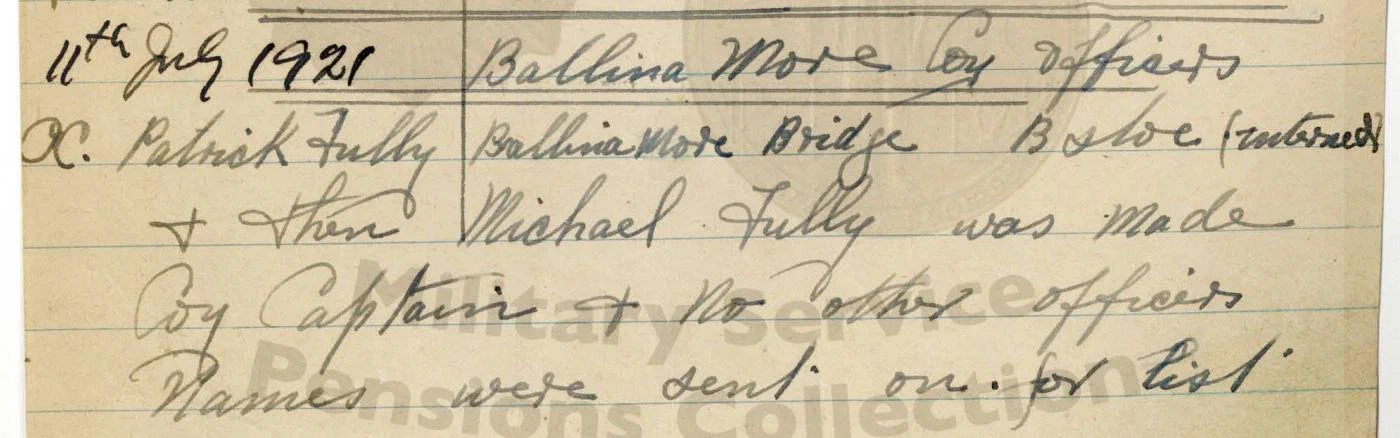
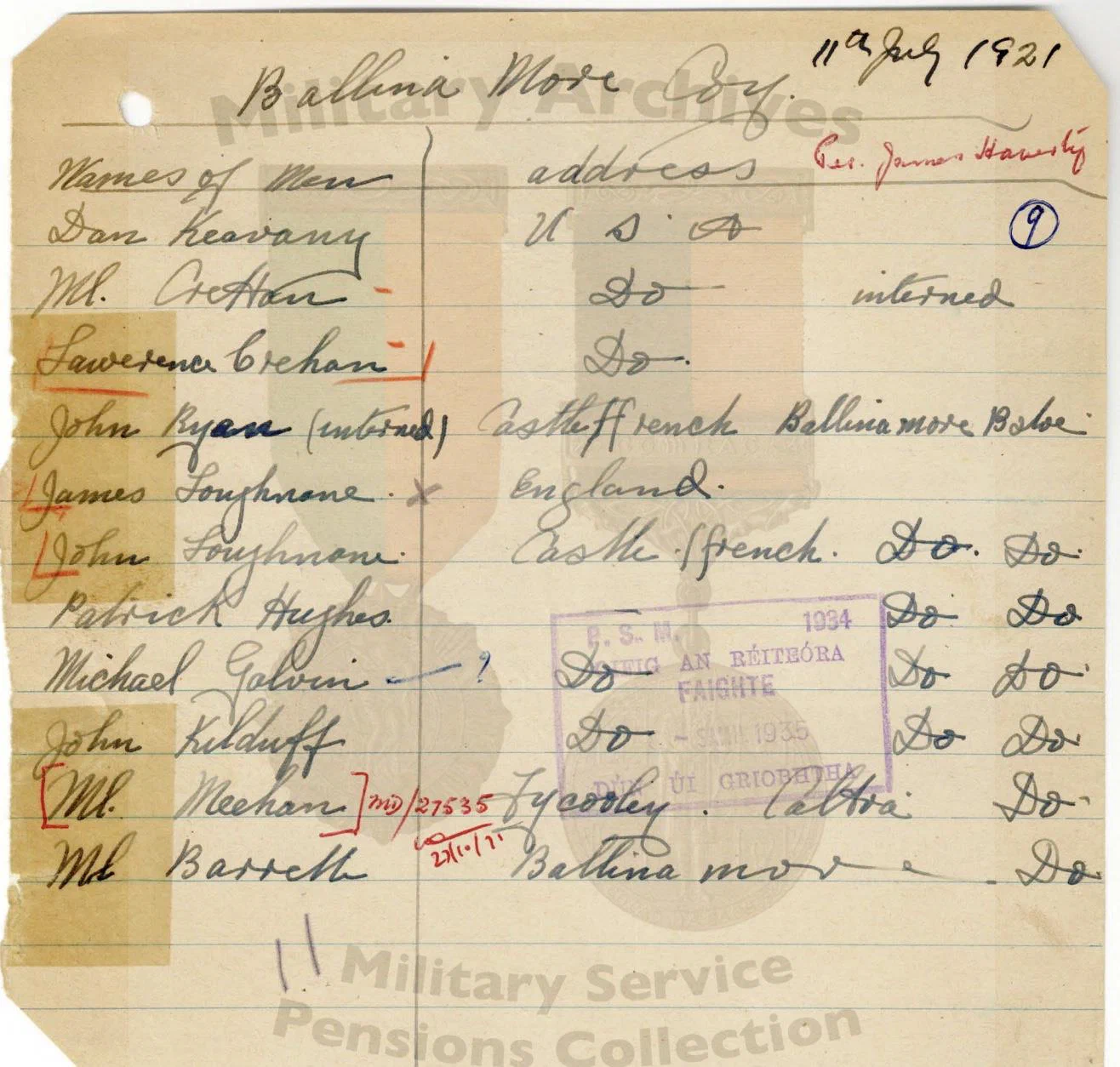
The addresses given are those at the time the list was compiled in 1934.
Pat “Fiscal” Tully from Riversdale was company captain for Ballinamore and he would have reported to Mountbellew Battalion OC, James Haverty. The “Fiscal” nickname indicates he was also in charge of funds and expenditure at company or maybe battalion level. His younger brother, Mick Tully became company captain when Fiscal was interned.
These records from 1934 only list 13 names in total, short of the 16-member count indicated on page 4 of the roll for Ballinamore Coy [2], so it’s likely a few names are missing or were not in active service in the 3 months leading up to the 11 July 1921 critical date.
Michael Barrett, at the end of the above list, was Quartermaster for Ballinamore Coy, in that he looked after the guns and ammunition, which he kept in or around his house. Hence strictly speaking, he should have been on the officers list and qualify for a slightly bigger pension!
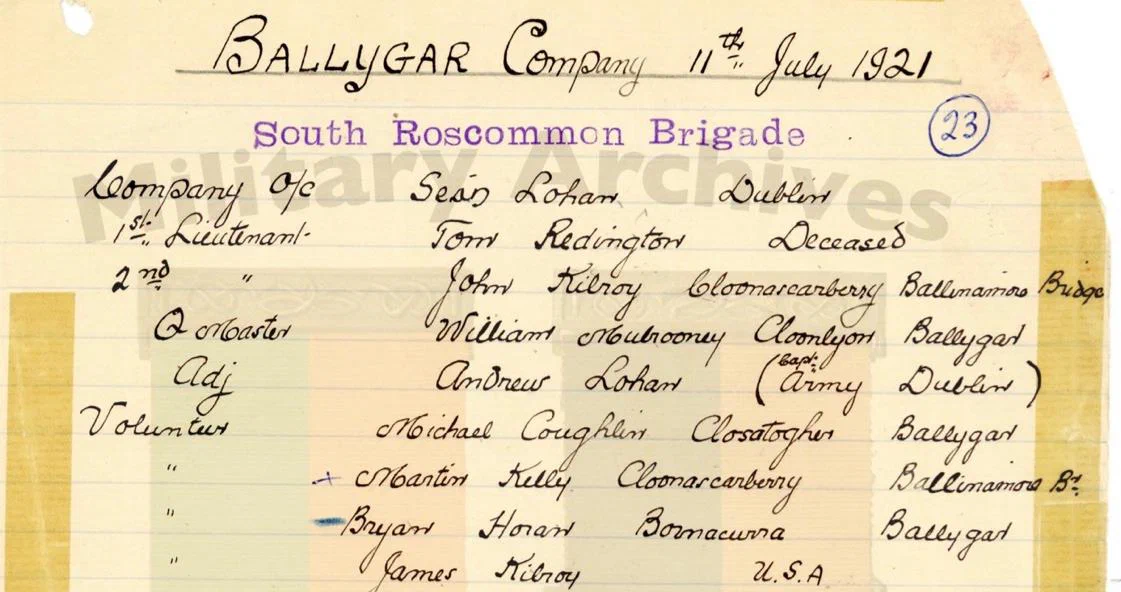
The boundary between Ballinamore and Ballygar Companies was roughly around Toghergar church, so Volunteers John Kilroy, Michael Coughlan, Martin Kelly and Bryan Horan from the Cloonascarberry area, are listed with Ballygar Coy. Here is part of that list from the archives [3].
In 1920 the IRA launched a nationwide campaign to cripple the British administration in Ireland by targeting courthouses, tax offices and police stations. The objective was to enforce a public boycott of British law, destroy Crown records and establish the authority of the rival Dail courts. Hence, in the summer of 1920, a plan was made to attack and destroy Ballinamore RIC Barracks and Courthouse.
Burning the place to the ground was not an option here, due to the risk of fire spreading to the adjoining Taylor’s public house. Instead, it was decided to manually demolish the courthouse and barracks and to take the court records away for burning elsewhere. This would require a lot of manpower so reinforcements were called in from across the battalion area.
The barracks was already mostly evacuated, other than the sergeant and his family who were still living there, as the policy during that period of the war was to house the RIC together in larger numbers for security and to patrol the area in lorries. Ballygar barracks was the main RIC base with a lot of the Black and Tans billeted on the grounds of Mount Talbot House.
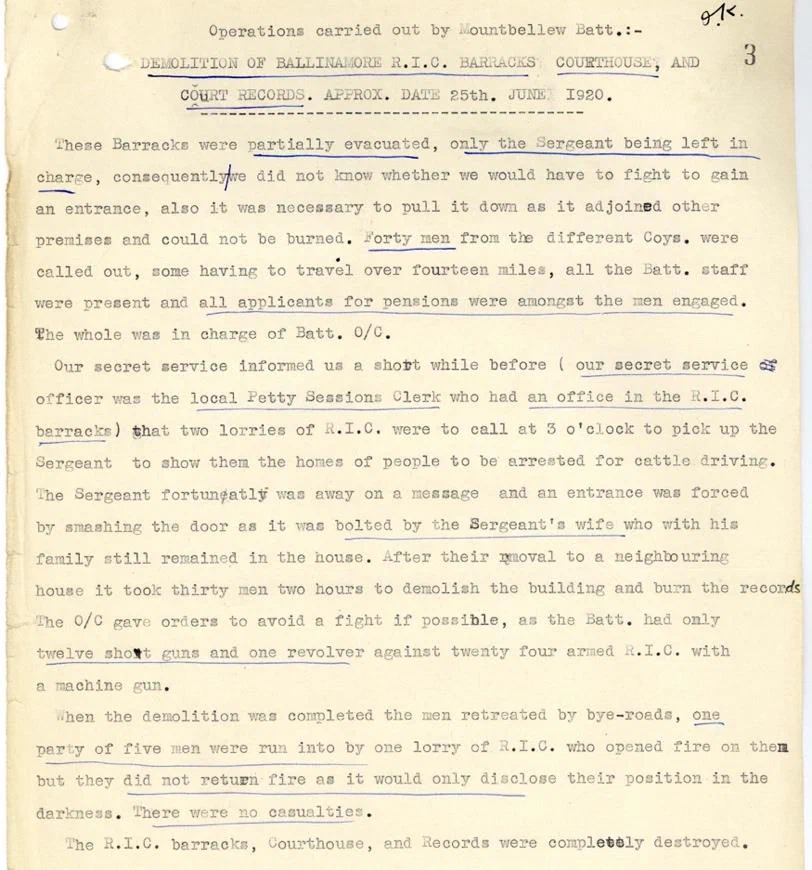
For the Ballinamore attack, the Battalion O/C gave the order to avoid a fight if possible as all the weapons they had were 12 shotguns and a single revolver, against 24 armed RIC / Black and Tans with a machine gun.
The IRA had inside information from the court petty sessions clerk, who had an office in the RIC barracks — his name is very likely to have been James F. Kelly [4]. He tipped them off that two lorries of Tans/RIC were to call on a particular day at 3pm to pick up the sergeant, to show them the houses of people to be arrested for cattle driving. It was therefore decided to attack the barracks that evening.
There is some confusion about the actual date of the attack; the date given in the Brigade Activity Report [5] is “25 June 1920 approx.”, whereas the pension file of John Ryan [6] gives a date of 17 May 1920. This seems more definite and was accepted by the pensions commission. Either way, the attack took place during the summer of 1920.
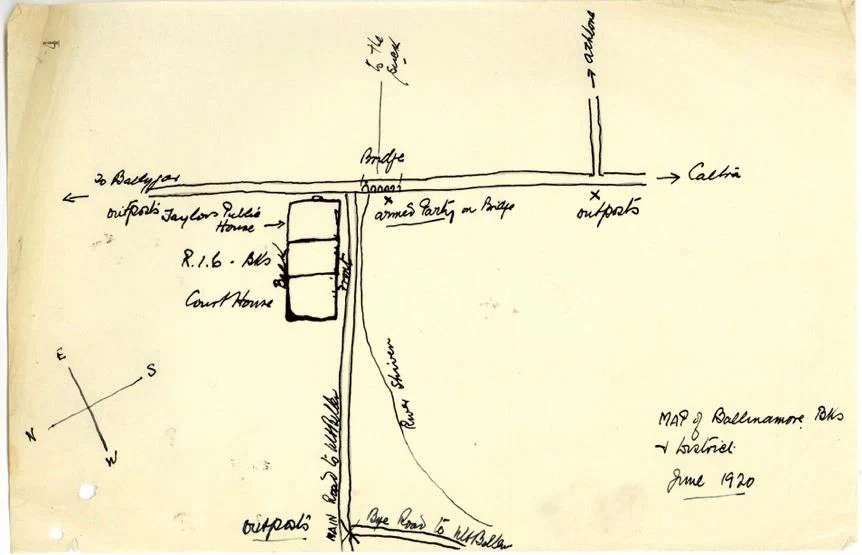
Below is the sketch-map of the attack plan, taken from the Brigade Activity Report. It shows that lookouts were placed on all of the roads leading into Ballinamore, with an armed IRA party located on the bridge.
They smashed down the door that the sergeant’s wife had bolted and brought her and her family across to a neighbouring house. It took 30 men two hours, using picks, sledge-hammers and crowbars to demolish the courthouse and barracks. John Ryan from Castleffrench took the court records away for burning. The pension files also mention that a lorry load of Tans arrived on the scene just after they had finished the demolition.
The men withdrew, cycling home via byroads to avoid detection.
A party of five of the men encountered an RIC lorry on their retreat, which opened fire on them. The IRA men did not return fire, so as not to disclose their position in the darkness, and escaped safely.
There were no casualties on the IRA side. The RIC barracks, courthouse and court records were completely destroyed.
Since the Ballinamore Coy members were likely known to the RIC, they all went on the run after the attack. The RIC and Black and Tans tried to extract information on those remaining but to no avail. Nobody from Ballinamore Coy was arrested until the end of 1920.
In one of the days after the attack, a lorry load of Tans called to the house of John Keaveney, a brother of Dan Keaveney and brother-in-law of Michael Barrett, both of whom were on the run. The house originally was the gate house to Curraghboy Lodge, the big house of Martin ffrench. The front door at the time was a glass paneled door, of the type used in Curraghboy Lodge.
The Tans smashed most of the glass panes and broke into the house to interrogate John Keaveney about the whereabouts of the IRA men on the run. In the effort to get information from him, they fired gun shots close to his left ear, (he had poor hearing in that ear for the rest of his life), tied a rope around him and dragged him down the road with the other end of the rope attached to the back of the lorry. They pulled / carried him down the road towards Ballygar, gave him several beatings and finally threw him in over the bridge on the Ballygar road, into the Cloonlyon river.
The Tans then pulled one of the Brannellys who lived nearby, along with a Kilroy relative of a member of Ballygar Coy IRA, and gave them similar treatment. They ended up thrown over the bridge at Mount Talbot, into the River Suck.
All three survived this ordeal and made their way home again. No useful information was given to the Tans; there are no records of any arrests or charges specifically related to the destruction of Ballinamore Barracks or Courthouse.
Aftermath
John Ryan, from Castleffrench (Ballinamore Coy) also participated in the Caltra ambush, on 14 July 1920, where two RIC men were shot at but escaped.
He had collected a gun from Ballinamore Coy QM, Michael Barrett and brought it to the Caltra ambush. He was arrested for this on 14 December 1920 and sentenced to penal servitude for life.
He was imprisoned in Galway gaol along with Thomas Kilroy, the CO of Caltra Company, who also got a life sentence for his part in the ambush.
On 24 Nov 1921, Ryan and Kilroy participated in a prison riot and set fire to the gaol, while singing “The Soldier’s Song” in protest at the treatment of another prisoner [7].
They were released on 12 Jan 1922 as part of the general amnesty following the signing of the Anglo-Irish Agreement on 6 Dec 1921. In this photo, published in the Connacht Tribune on 21 Jan 1922, John Ryan is 3rd from the left on the back row and Thomas Kilroy is 5th from the left on the middle row.
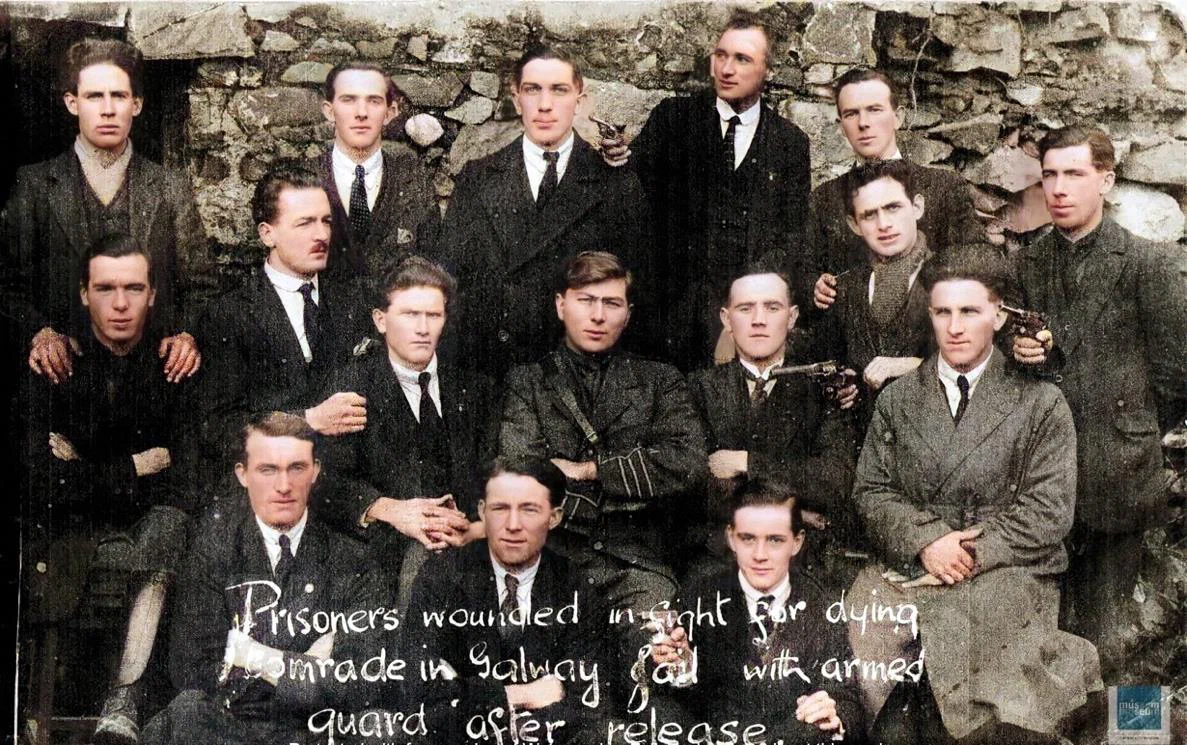
Released prisoners photographed at Galway gaol, published in the Connacht Tribune on 21 January 1922. Fiscal Tully was rounded up some time during 1921 and interned in Rath Camp, The Curragh. His younger brother Mick Tully took over as captain of Ballinamore Coy while Fiscal was interned, up until the start of the Truce.
There was a split in Ballinamore Coy when the Civil War started up in July 1922. Mick Tully joined the Free State army as did Tom Keaveney, Dan’s brother. Michael Crehan from Ballyvoneen took over as company captain for the anti-treaty irregular faction with John Ryan named 1st Lieutenant.
The list of anti-treaty IRA members (with their 1934 addresses) is shown here, [8].
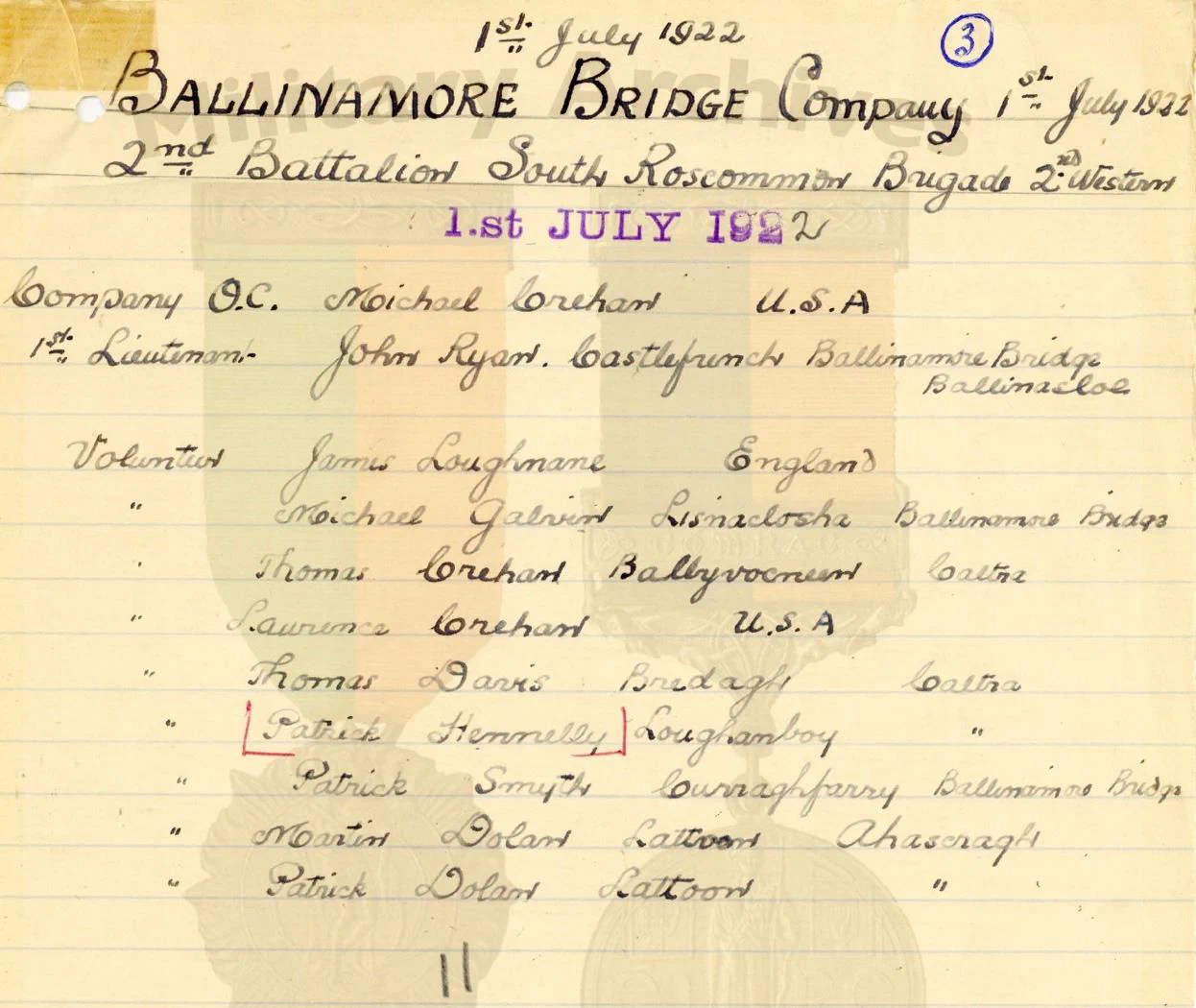
Nominal roll of Ballinamore Bridge Company, 2nd Battalion South Roscommon Brigade, at 1 July 1922. The others not here from the original 1921 list are assumed to have remained neutral during the Civil War.
Despite being the eldest son, Fiscal Tully emigrated to New York in November 1923. His younger brother, Mick Tully was one of the army officers who disputed his demobilization order after the civil war and made a submission to the enquiry into the army mutiny of 1924, [9]. There was also significant army back pay due to him, for which a question was asked in Dail Eireann, [10]. When he finally got the money, he used it to stock the farm at Riversdale. All was going well until Fiscal suddenly arrived home from New York in 1927.
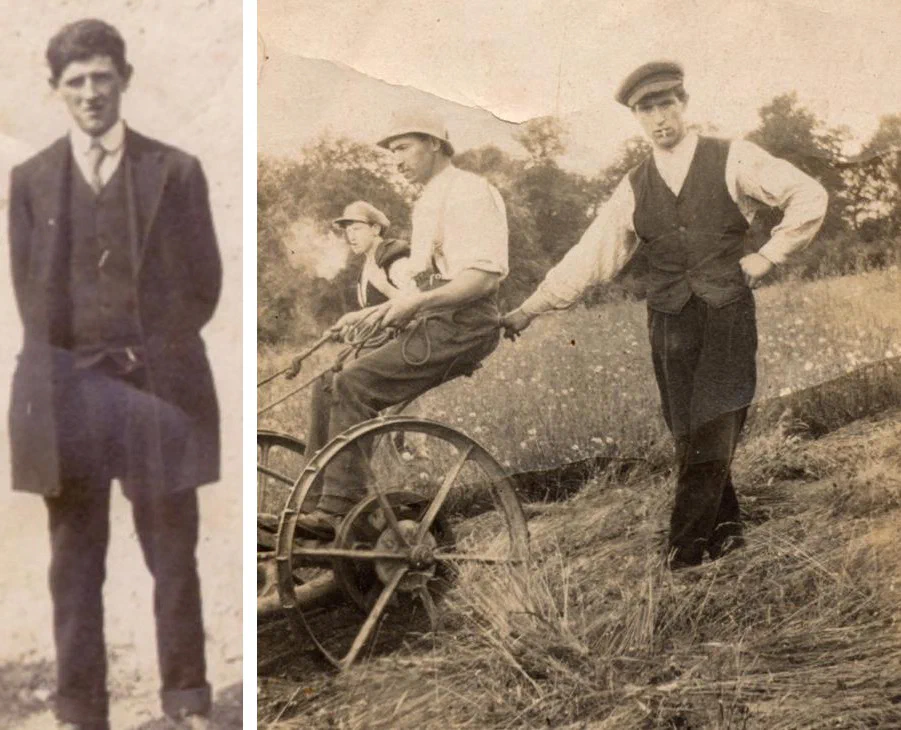
Fiscal Tully standing on the left, Mick Tully on the right and John Keaveney sitting on the machine. Tommy Tully is in the background. Photos circa 1919 Mick sold up all the stock he had bought and emigrated to Boston in May 1927. He married Katie Mannion (originally from Ballinamore), there in 1929.
Meanwhile Fiscal took over the Riversdale farm, but had more interest in hunting and fishing than farming, so he never brought it back to the level that Mick had it at.
He married Katie Crehan from Ballybane in 1935. They had no children, so when Fiscal died in 1974, his sister Bridie Tully and her husband Dick Ryan, inherited Riversdale.
In April 1924, Dan Keaveney emigrated to America. He disembarked at Halifax, Nova Scotia, Canada but finally ended up in The Bronx, New York.
Dan and his brother Tom had worked together as carpenters in Ballinamore. The story goes that they had a falling out when Tom took the pro-treaty side and joined the Free State army. Their father James Keaveney finally gave them an ultimatum that they had to make up or else clear out, so Dan emigrated.
Tom was recorded at Tuam barracks on the 12 Nov 1922 night of the National Army Census. He had enlisted in Mountbellew on 24 July 1922, which was less than a month after the start of the Civil War. He joined at NCO rank and according to his army record, [10], had previously held the rank of lieutenant for one year, while in the IRA.

Thomas Keaveney’s entry in the National Army Census return for Tuam, 12-13 November 1922. Tom was stationed in Athlone and later in Buncrana, doing barracks repair work, as part of the Engineers Corp. He was demobilized from the army in January 1926. Shortly afterwards he also emigrated to America, to work as a carpenter. He had made his peace Dan by then and lived just around the corner from him in the Bronx. Tom died in New York, at the young age of 45, in 1940. He was buried in what would become the family plot of his older brother James Keavney Jnr., in St. Charles Cemetery, New York.
While in the Bronx, Dan married Margaret Mallooly, originally from Ahascragh, in 1929. They had two daughters, both of whom married descendants of Italian immigrants. Dan passed away in 1955.
Andrew Michael “Sonny” Hughes, originally from Castlecoote, County Roscommon, bought the public house, grocery and adjoining premises from Thomas Henry Taylor, on 29 Jan 1929. Shortly afterwards, the now familiar “A.M. Hughes” sign appeared over the door.
The Taylors were protestants and while they got on well with their neighbours in Ballinamore Bridge, they became increasingly nervous about their situation after the attack on the adjacent barracks and courthouse buildings.
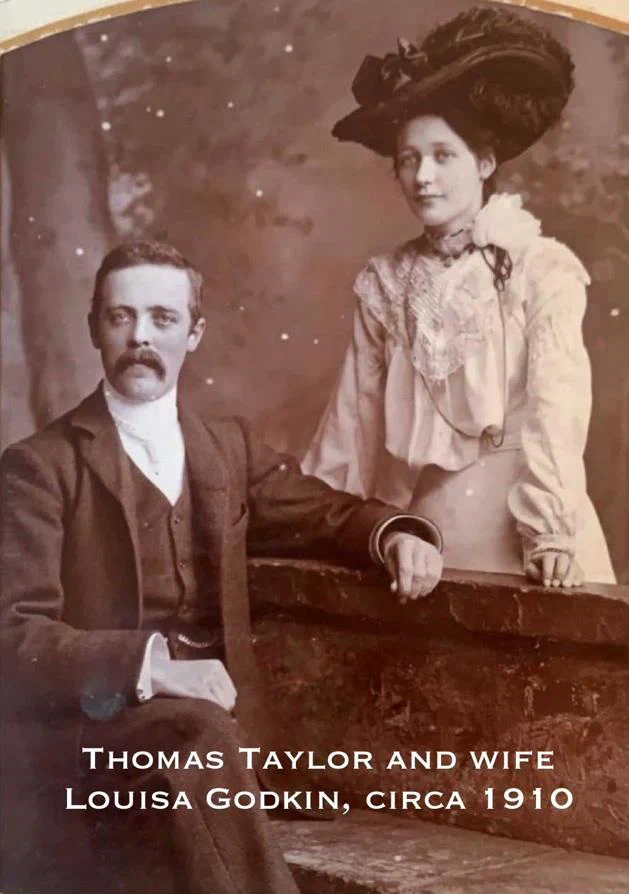
Thomas Taylor and wife Louisa Godkin, circa 1910. 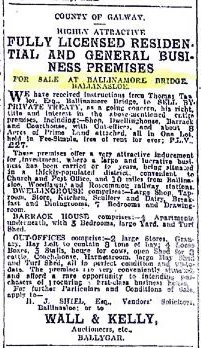
Newspaper notice advertising the sale of the fully licensed residential and general business premises at Ballinamore Bridge, including the barrack house and courthouse. Hence, the premises went up for sale in the 1920s. While the internals of the courthouse and barracks buildings were destroyed in the IRA attack, their shells were still more or less intact and so these buildings were also included in the sale.
The Taylors moved up the country to Ballivor, Co. Meath. Thomas passed away in 1935 and Louisa in 1968. They had no children.
Sonny Hughes rented out living quarters, constructed in what was previously part of the RIC barracks, to Mark Killilea TD during the 1930s. This section had to be re-roofed as there had been some fire damage arising from the attack, despite what’s indicated in the brigade activity report.
Mark Killilea grew up in nearby Cloonabricka and served in IRA Flying Columns in South Wexford and West Mayo, [11], during the War of Independence and Civil War. He was one of the founding members of Fianna Fail and elected to Dail Eireann as a TD for Galway in 1927. His rented accommodation was on the Newbridge side of the archway at Hughes.
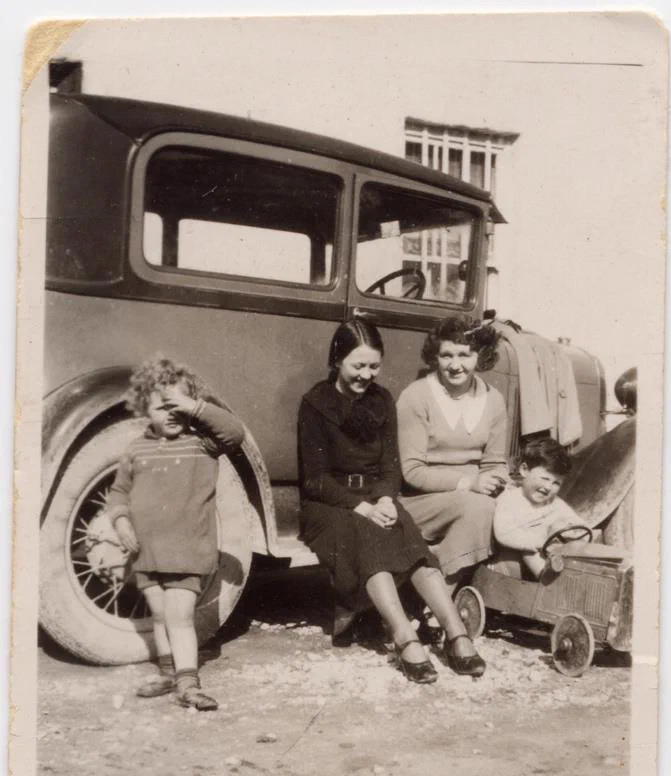
Mark Killilea’s Ford Model A car outside the rented accommodation, circa 1936. This photo shows Mark Killilea’s Ford Model A car, parked outside the rented accommodation circa 1936. Notice the bars remaining on the downstairs window from the time it was a barracks. Mark’s sister Dotie Killilea is sitting on the right of the running board; she was minding Mark’s two children Marie and Padraic.
Their future younger sibling, Mark Killilea Jnr., (known as Markseen to differentiate him from his father), was born in September 1939 and would become a TD and MEP in the 1970s-80s.
The girl in the dark dress is Mollie Keaveney, daughter of John Keaveney and Mary Anne Barrett. She died of TB a couple of years later, in June 1939, after a one-year illness.
Pake Hughes, member of Ballinamore Coy until the Truce, was active with the Blueshirts during the 1930s. There were regular heckling and physical confrontations with the Republican faction, led by Mark Killilea, at collections outside mass etc.
Pake married Bridget Keane from Caltra in 1940 and when he died in 1980, he was buried with full military honours.
John Keaveney replaced the glass paneled door smashed by the Black and Tans with a more solid front door. Here he is, circa 1940, sitting outside the replaced door with his good ear towards the camera.
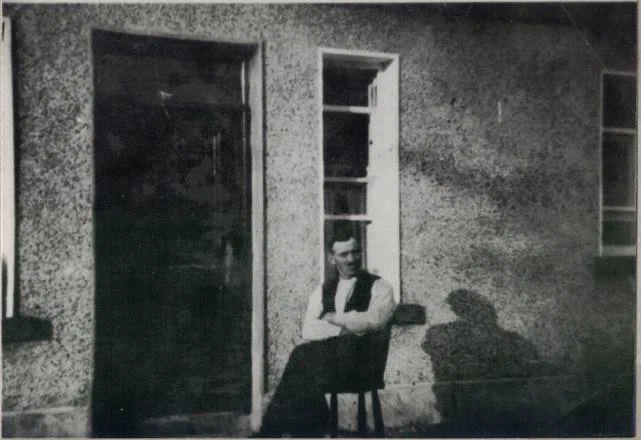
John Keaveney outside the replaced front door, circa 1940. He stored the door with the broken panes of glass up in the loft of a barn, where it still remains to this day.
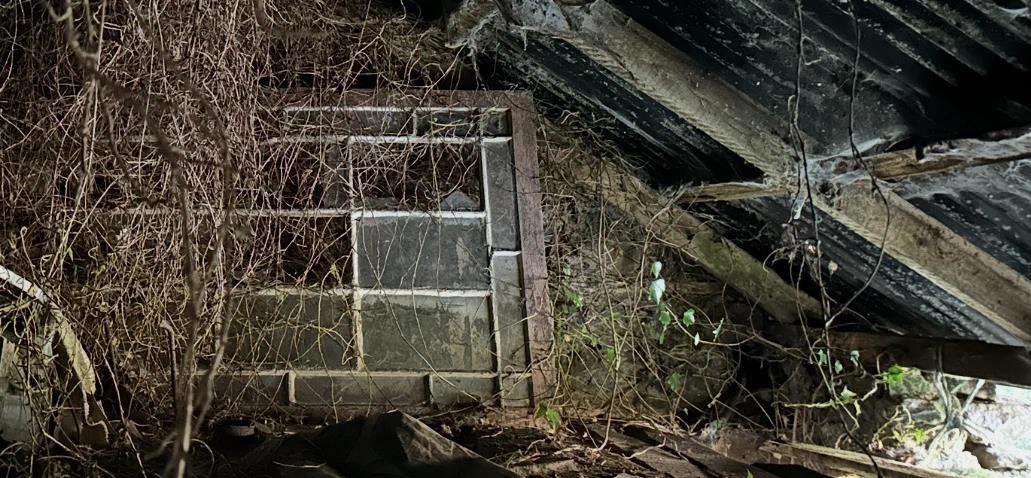
The original glass panelled door, still in the loft of the barn. In the 1940s, the Government introduced a medal to award IRA service from 1917-21, called the “Black and Tan Medal”. The Military Archives have medal application records for most of the Ballinamore Coy members on the 1921 list. Some didn’t apply, especially if they were living abroad. Here is a photo of Michael Barrett’s Black and Tan medal, which he applied for and was awarded in 1953.
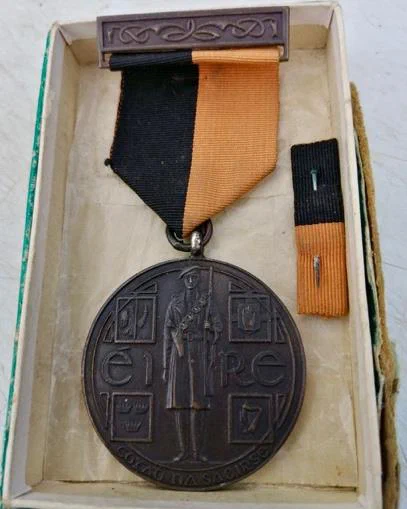
Michael Barrett’s Black and Tan medal, awarded in 1953. In the 1980s, this Colt 45 revolver was found inside a wooden partition wall, upstairs in Michael Barrett’s house. Fiscal Tully had mentioned over the years that “there are guns in that house” since Barrett was the Ballinamore Coy Quartermaster.
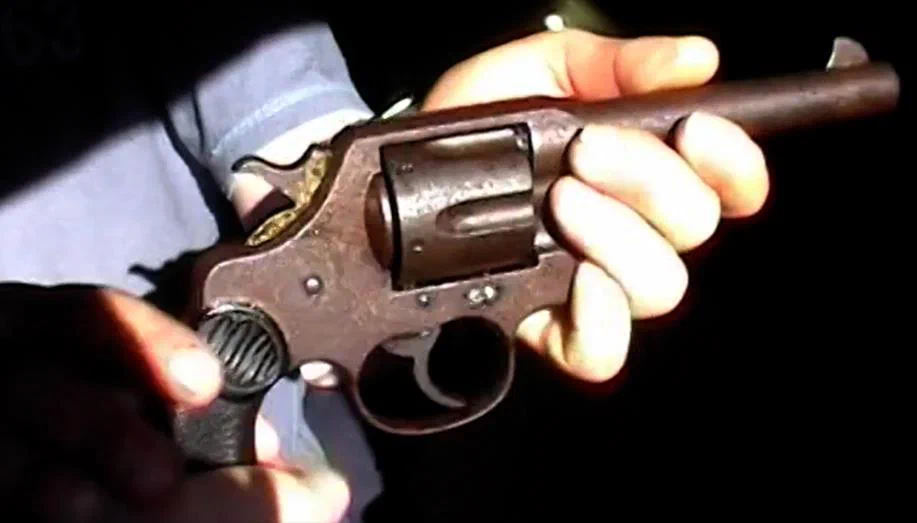
The Colt 45 revolver found inside a partition wall in Michael Barrett’s house. 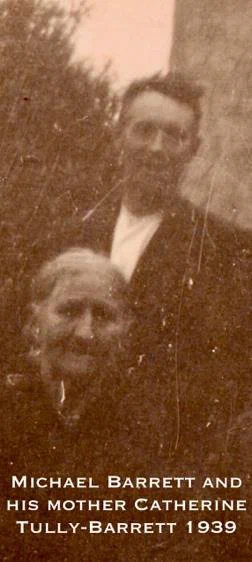
Michael Barrett and his mother Catherine Tully-Barrett, 1939. This is believed to be the single revolver referred to earlier in the battalion report on the Ballinamore Barracks attack. It is also likely to be the gun that John Ryan brought to the Caltra Ambush of 14 July 1920, where two RIC were fired at.
Cumann na mBan was also active in Ballinamore but the only member mentioned from the area in the Military Archives is Brigid Loughnane from Caltra. There is evidence of a Ballinamore branch from the flag made by Ellie Barrett, a younger sister of Michael Barrett. Ellie had been going out with Pake Hughes but this relationship broke up (perhaps over politics?) and she emigrated to Boston around 1929.
Ellie’s older sister Bridget was already in Boston since 1912. She had sailed from Cobh, aged 19, a week after the Titanic went down. In the New World, she changed her name to Agnes Barrett, (as a lot of Bridgets did back then in order to avoid discrimination), and in 1920, she married Johnny Mulrooney, brother of the legendary Ballygar Company IRA members, Willie and James Mulrooney.
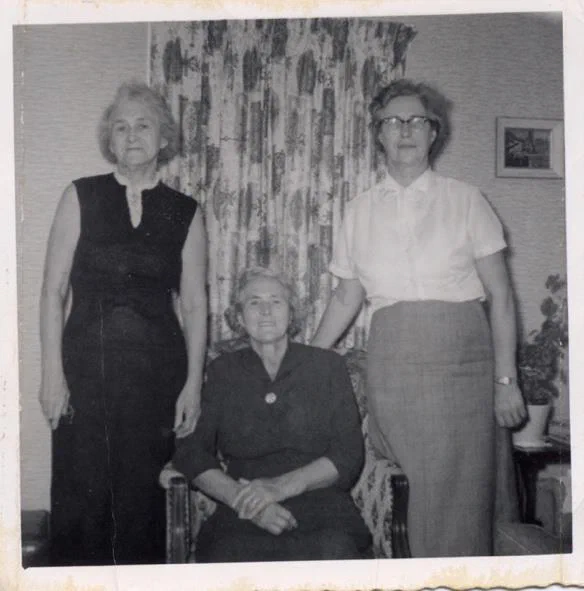
The three Barrett sisters in Boston, around 1958. Here is a photo of the three Barrett sisters, taken around 1958 when Mary Anne Barrett, wife of John Keaveney, travelled to Boston to visit Agnes (left) and Ellie (right).
When she went to America, Ellie had left the Cumann na mBan flag behind her in Ballinamore, in the care of Mary Anne. Here is a photo of it, taken almost 100 years later at the time of the 1916 centenary.
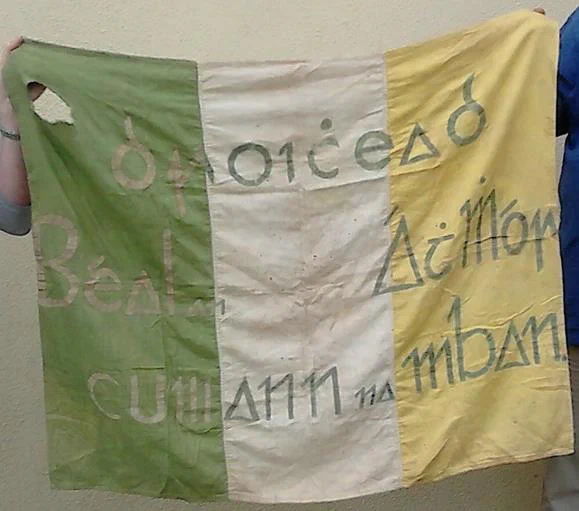
The Cumann na mBan flag made by Ellie Barrett, photographed at the time of the 1916 centenary. This nicely wraps up the story from that time, when the brave men and women of Ballinamore, had their fight for Irish freedom!
References
Hyperlinked if available online.
- MA-MSPC-RO-266 — Pg. 5 - Mountbellew Battalion Area at www.militaryarchives.ie
- MA-MSPC-RO-232 — East Galway Nominal Roll for 11 July 1921, pages 4,6,7,10,41
- MA-MSPC-RO-245 — South Roscommon Nominal Roll for 11 July 1921, page 50
- 1919 Thom’s Directory — County Galway - Petty Sessions Districts, page 1193
- MA-MSPC-A-27 - South Roscommon Brigade Activity Report, pages 9-10
- MSP34REF4329 - John Ryan’s Pension File at www.militaryarchives.ie
- Galway Political Prisoners 1922 at www.galwaycitymuseum.ie
- MA-MSPC-RO-267 — South Roscommon Nominal Roll for 1 July 1922, page 25
- Dáil Éireann debate, 20 May 1924 - Written Answers - Payment of Army Accounts
- VR21919 — Service Record for Cpl. Thomas Keaveney in the Military Archives
- MSP34REF12183 — Mark Killilea’s Pension file at www.militaryarchives.ie
Mike Keaveney, August 2026
With contributions from Enda Keaveney, Matthew Hughes and Ronan Keaveney